Material selection is routinely treated as a cost-tier decision — nylon is cheap, stainless is expensive, pick accordingly. In wind energy, that framing misses two things that actually matter: the corrosion environment determines service life, and whether the installation carries single-core AC cables determines a hard electromagnetic constraint that cost cannot override.
§ 01 Nylon (PA66): lightweight, insulating, UV-dependent
Glass-fibre-reinforced PA66 is the standard low-cost option. Its advantages — light weight, electrical insulation, no magnetic behaviour — make it well-suited to sheltered low-fault-current circuits.
Its limitations are clear: mechanical strength is lower than either metal, ruling it out for high fault-current circuits at extended spacing; it has a working temperature ceiling; and plain nylon will embrittle under prolonged UV exposure — outdoor or exposed tower locations require a UV-stabilised (weathering) grade.
§ 02 Aluminium alloy: strength without magnetic penalty
Cast aluminium — LM6 and similar alloys — combines high mechanical strength with significantly lower weight than stainless steel. It is inherently non-magnetic, making it fully compatible with single-core AC cable installations without the induction heating risk of ferrous materials.
Its limitation is corrosion resistance in aggressive environments. Bare aluminium pits in salt-laden or highly humid conditions; anodising or coating is required for offshore or coastal installations.
§ 03 316 Stainless steel: when corrosion is the governing constraint
When the environment is the primary design driver, austenitic stainless steel is the answer. Grade 316 contains 2–3% molybdenum, which dramatically improves resistance to chloride pitting — the dominant corrosion mechanism in offshore and coastal environments. At C5-M corrosion category (marine), 316 is the standard selection; 304 is not recommended without additional surface treatment.
304 and 316 are both austenitic and essentially non-magnetic (relative permeability μᵣ ≈ 1.003–1.05), satisfying the single-core constraint alongside the corrosion requirement.
§ 04 The critical rule: non-magnetic material for all single-core AC circuits
This is the most technically important — and most often violated — material selection rule for cable cleats.
A single-core AC conductor is surrounded by an alternating magnetic field. If a ferromagnetic material (mild steel, galvanised steel, or any steel with significant magnetic permeability) encircles it, that material forms a magnetic circuit. The alternating field induces continuous hysteresis and eddy-current losses in the cleat body — the cleat heats continuously in service, potentially reaching temperatures that damage the cable sheath and adjacent structure.
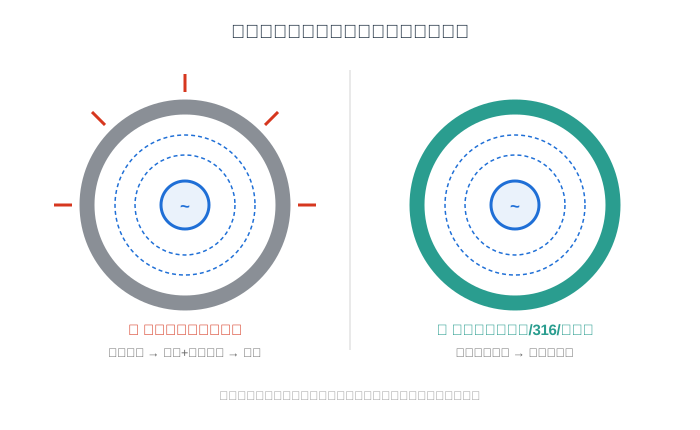
✓ Acceptable — Aluminium alloy, austenitic stainless steel (304 or 316), engineering nylon (PA66). All three are non-magnetic.
This rule applies to single-core installations regardless of formation — single-cable cleats and trefoil cleats alike. Three-core multicore cables present much less risk because the three-phase magnetic fields largely cancel externally.
§ 05 Decision summary
Compress the decision to one rule: match material to environment first, then confirm non-magnetic for single-core circuits.
- Sheltered, low-fault, weight/cost sensitive → UV-stabilised PA66 nylon;
- Onshore, medium-to-high fault current → aluminium alloy;
- Offshore / coastal C5-M → 316 stainless steel;
- Any single-core installation (any of the above) → confirm material is non-magnetic.
For the full six-parameter selection framework that places material within the complete decision, see Cable Cleat Selection Parameters.