The power cables running down a wind turbine tower look perfectly still in normal operation. During a fault, they can be subjected to forces hundreds of times greater than anything seen in service — enough to tear fixings loose, whip cables into adjacent equipment, and sever conductors. The root cause is a single, often overlooked physical quantity: short-circuit electromagnetic force.
Understanding it is a prerequisite for reading cable cleat selection correctly.
§ 01 How large does fault current actually get?
Under normal load, cables carry rated current. A phase-to-phase or earth fault causes current to surge to tens of times rated value within milliseconds — but even that steady-state figure is not the worst case.
Because the fault occurs at a particular point in the AC voltage cycle, a transient DC offset is superimposed, driving the first current peak (iₚ) well above the RMS fault level — typically around 2.5× the steady-state RMS value for standard power systems.
Mechanical damage occurs at this first peak, not at the steady-state level.
§ 02 Why do parallel conductors exert force on each other?
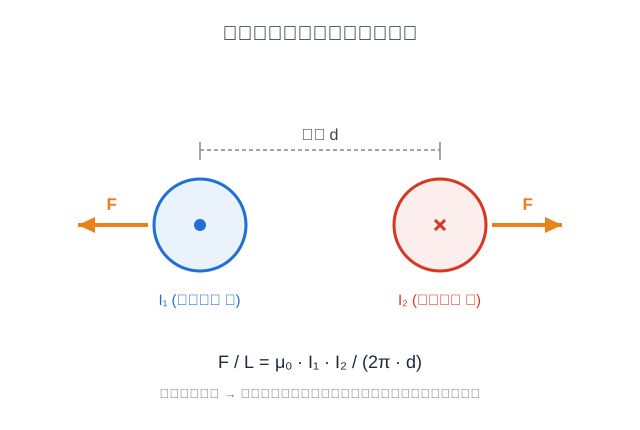
Every current-carrying conductor generates a magnetic field. When two conductors run in parallel, each sits in the field produced by the other and therefore experiences a force — the electromagnetic (Lorentz) force.
The relationship is concise:
where F/L is force per unit length, I₁ and I₂ are the conductor currents, d is centre-to-centre spacing, and μ₀ is the permeability of free space. Three rules follow directly:
- Force scales with the product of the currents. When both conductors carry the same fault current, force is proportional to current squared. Double the current, quadruple the force. Ten times the current, one hundred times the force.
- Force is inversely proportional to spacing. Cables closer together experience larger mutual forces.
- Direction depends on current sense. Parallel currents attract; opposing currents repel.
§ 03 How large? A concrete number
Take two single-core cables 50 mm apart, fault peak 50 kA:
≈ 10,000 N/m — roughly one tonne of lateral impulse per metre of cable
Applied instantaneously, as a shock load, not a static force.
Cable ties, light-duty clips, or cleats installed at excessive spacing have no meaningful resistance to forces at this scale.
§ 04 Cable whip: how failure propagates
Fault current is AC, so the electromagnetic force oscillates at twice the supply frequency — alternately pushing conductors apart and pulling them together. Inadequately restrained cables thrash violently under this alternating impulse. The industry term is cable whip.
The failure sequence is predictable:
- Cable sheath and insulation abrade against structure and adjacent cables, seeding secondary fault sites;
- Fixings are pulled off or deformed; cables displace from their routed path;
- Whipping cables strike the tower wall, platforms, or adjacent switchgear;
- In severe cases, conductors are mechanically severed by the electromagnetic force alone.
The cable fixing system is only truly tested at the moment of fault — not during years of normal service.
§ 05 How cable cleats resist and redistribute the force
A cable cleat anchors cables to the tower structure so that the impulse is transferred to the structure rather than absorbed by the cable itself. This requires:
- Adequate mechanical strength — the cleat body must not fracture or open under the rated peak current;
- Correct installation spacing — halving the span between cleats reduces the bending moment at each cleat; spacing is a primary design parameter, not a site estimate;
- Secure fastening — cables must not slip out of the cleat during the impulse;
- Non-magnetic material for single-core cables — avoids induction heating from the alternating field.
This is why professional cable cleats carry a short-circuit withstand rating in kA, verified under IEC 61914 type testing — and why that number is absent from cable ties and generic clips.
§ 06 Summary
Short-circuit electromagnetic force is invisible during normal service and potentially catastrophic during a fault. Fault current reaches tens of times rated value; peak current adds a further 2.5× multiplier; and force scales with the square of that peak — yielding lateral impulses close to one tonne per metre. The entire purpose of a cable cleat is to hold through that instant.
For the selection workflow — how to convert Isc into a cleat kA rating and pair it with the correct installation spacing — see Cable Cleat Selection Parameters.