A common root cause of cable fixing rework: the cleat was ordered based on cable OD and nothing else. It arrived on site, was installed, and passed every visual inspection — then the wrong formation type was flagged in an audit, or the kA rating turned out to be below system peak current. Getting six parameters right simultaneously is the only way to avoid that pattern.
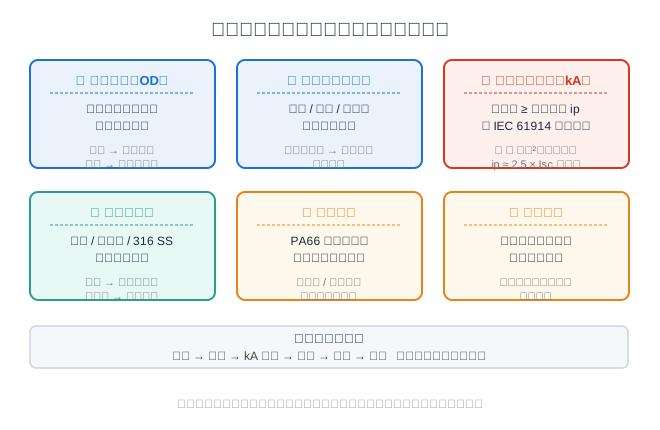
§ 01 ① Cable OD: measure, don't estimate
Every cable cleat has a declared applicable OD range. The actual OD of a cable varies with conductor cross-section, insulation wall, sheath material, and manufacturer tolerances — two cables with the same nominal cross-section from different manufacturers can differ by several millimetres in OD.
Always use the measured or datasheet OD against the cleat's declared range. A cleat that is too loose allows axial slip and lateral displacement during a fault; one that is too tight compresses the sheath and damages insulation over time.
§ 02 ② Installation formation: the first fork in the decision tree
Formation determines which cleat type is required:
- Single-core — half-shell single-cable cleat;
- Flat (trefoil) three-core multicore — three-hole flat cleat;
- Trefoil formation (three single-core in equilateral triangle) — dedicated trefoil cleat that holds all three conductors in position simultaneously.
Trefoil formation is not optional for three-phase single-core installations — it is the engineering-correct arrangement. The resultant electromagnetic force in trefoil is substantially lower than in flat formation, and only a proper trefoil cleat locks the geometry to preserve that advantage during a fault. See Trefoil Formation for the full physics.
§ 03 ③ Short-circuit withstand (kA): the most frequently missed parameter
This figure distinguishes a cable cleat from everything else on the market. Electromagnetic force between conductors scales with the square of current. At a 50 kA peak, each metre of cable sustains close to one tonne of lateral impulse. A cleat that has not been tested at that level provides no engineering assurance at that level.
1. Obtain steady-state prospective fault current Isc (RMS) from the protection study.
2. Apply peak factor κ (conservatively 2.5): iₚ = 2.5 × Isc.
3. Cleat declared kA rating ≥ iₚ — verified by IEC 61914 type test report, not catalogue declaration alone.
§ 04 ④ Material and environment: two constraints in one
Material selection is governed by two independent requirements that must both be satisfied:
Corrosion resistance governs the material family: UV-stabilised nylon (PA66) for sheltered low-corrosion locations; aluminium alloy for onshore medium-corrosion; 316 stainless steel for offshore C5-M environments.
Single-core magnetic constraint adds a hard rule regardless of environment: any cleat encircling a single-core AC cable must be non-magnetic. Ferromagnetic steel forms an induction heating circuit; aluminium alloy, 304/316 austenitic stainless, and engineering nylon are all acceptable. See Cable Cleat Materials.
§ 05 ⑤ Working temperature: the hidden ceiling for polymers
Metallic cleats require no temperature check in most wind turbine installations. Polymer cleats — PA66 nylon — have a declared upper working temperature above which mechanical strength drops sharply.
Locations to check: converter rooms and transformer bays at tower base, where full-load thermal rise can add 40–60 °C; high-ambients in tropical climates; cable runs with sustained high current generating self-heating. If working temperature exceeds the nylon rating, switch to a metallic material.
§ 06 ⑥ Installation spacing: the last tuning variable
Cleat spacing and kA rating are not independent. The manufacturer's declared kA rating applies only at or below the maximum installation spacing stated in the test report. Increasing spacing reduces the effective short-circuit withstand of the installation, even if the cleat body is unchanged.
Spacing is also affected by cable self-weight on vertical runs — large-section cables accumulate significant axial load over long vertical spans. The detailed calculation is in Installation Spacing.
§ 07 Selection checklist
| Parameter | Verification point |
|---|---|
| ① Cable OD | Measured OD within cleat's declared applicable range? |
| ② Formation | Single / flat multicore / trefoil? Correct cleat type selected? |
| ③ kA withstand | Peak current iₚ calculated? Cleat rating ≥ iₚ per test report? |
| ④ Material | Corrosion category matched? Single-core → non-magnetic confirmed? |
| ⑤ Temperature | Polymer cleats within rated temperature at worst-case location? |
| ⑥ Spacing | Manufacturer's maximum spacing for this kA level written into drawings? |
All six parameters must be satisfied simultaneously. A specification that addresses five out of six is not a partial pass — it is an incomplete specification.